
Blessed are Those Who Doubt: A Christmas Message from St. Matthew
I am thankful that this year at Mass — year A in the three year Sunday cycle —we are following the Gospel according to Matthew in Advent (and we shall hear more from him at Epiphany).
Matthew has helped create Christmas as we know it: the Magi, the star, wicked Herod. He has his own concerns about the continuity of the new and old covenants, the location of Jesus in the lineage of king David — via Joseph, not Mary – and the fulfillment of prophecies from Isaiah and other prophets.
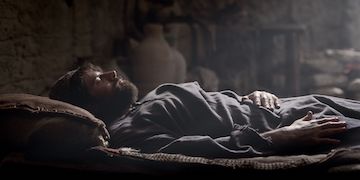
And he is also soberly realistic. He entertains and even seems to commend doubt.
Just the other day, on the Fourth Sunday of Advent, Matthew put before us Joseph, the good man who has no clue as to what is going on:
“This is how the birth of Jesus the Messiah came about: His mother Mary was pledged to be married to Joseph, but before they came together, she was found to be pregnant through the Holy Spirit.
“Because Joseph her husband was faithful to the law, he did not want to expose her to public disgrace. He had in mind to divorce her quietly.” (Matthew 1.18-19)
This is a classic scene of discernment.
Use what you do know, and do what you think you ought to do. Joseph ponders these options. Be righteous, have no mercy on Mary, shame her for this scandal. Or, because you are a righteous, therefore be compassionate. Send her home, quietly.
But of course, even if he acts rationally, piously, gently, Joseph will be on the brink of missing out on his role in the story of Jesus. So something more is needed.
The remedy lies not in any direct, waking encounter with an angel, as when Mary was visited by the Gabriel in Luke. It seems too that Mary had said nothing to Joseph about her pregnancy.
Rather, Joseph has a dream — the first of four dream-visitations Joseph experiences in Matthew 1-2:
“But after he had considered that option, an angel of the Lord appeared to him in a dream and said, “Joseph son of David, do not be afraid to take Mary home as your wife, because what is conceived in her is from the Holy Spirit. She will give birth to a son, and you are to give him the name Jesus, because he will save his people from their sins.” (1.20-21)
This message is neither that of the reasoning mind or the moral person, nor direct encounter. Joseph has an answer, in his sleep, in the dark of the night. But still he needs to decide whether to follow the angel’s instruction. He does.
Now one might think, if not really thinking, that the uncertainties surrounding the birth of Jesus would simply vanish later on, when the adult Jesus was announced by John the Baptist, and then began his own public ministry. How clear everything becomes!
But again, Matthew shows us how that was not the case. Look back to the Third Sunday of Advent. There we were confronted with a scene from later on in Matthew, Chapter 11. John the Baptist is now in prison, not because he preached repentance or pointed the way to Jesus — nothing so dramatic or special — but because he condemned the king’s tawdry marriage to his brother’s wife. He went to prison almost by accident, just as he will die by the cheap excuse of a dance and Herod’s foolish promise.
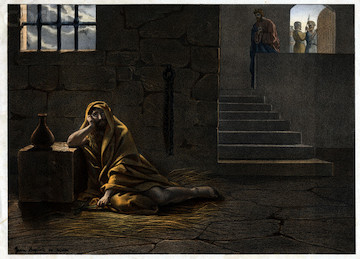
John had known before anyone else that the Messiah was coming and Jesus was that Messiah. Now in chains, he is having second thoughts:
“When John, who was in prison, heard about the deeds of the Messiah, he sent his disciples to ask him, ‘Are you the one who is to come, or should we expect someone else?’” (Matthew 11.2-3)
Perhaps you are not the one? Is there another on the way? Someone who will make it 100% clear that the world has changed?
Jesus deflects the question, speaking not of himself, but rather advising John about what you can see if you look around:
“Go back and report to John what you hear and see: The blind receive sight, the lame walk, those who have leprosy are cleansed, the deaf hear, the dead are raised, and the good news is proclaimed to the poor. Blessed is anyone who does not stumble on account of me.” (11.4-6)
The kingdom is happening, in small ways, a thousand times over. Look to your right and left, not up. Perhaps that is why Jesus ends with these enigmatic words,
“Truly I tell you, among those born of women no one has arisen greater than John the Baptist, yet the least in the kingdom of heaven is greater than he.” (11.11)
It is one thing, very remarkable, to recognize Jesus; it is a greater challenge to cast aside our expectations about what Jesus will be like; and it is greater still to look around us, and see the kingdom arising and erupting in small ways, healings, consolations, everyday miracles. Blessed are those who can see the kingdom already coming to be, right now.
It may be consoling then to bond with Joseph and John in this season when the rhetoric of faith is great — plus the symbols, and music and rhetoric — even while the world still rather cold, dark, violent. Faith is wishful thinking, or rather, we are in the presence of mystery.
Our reasoning and our moral compass may not tell us how to act or get involved in the work of God in the world right now. But a messenger, an inner dream-voice, may push us to get up, get involved, taking a great leap. Listen to the inner voice, be a Joseph.
We may not read of the coming Kingdom in the headlines, and God’s plan may seem ineffective in a dreary world that is all too sinful, the same as ever. But in reality, the kingdom of God is growing up in our midst. Open your eyes, be a John.