
Corpus Christi and the Body of Lord Vishnu
A year ago, I was finishing my year as President of the Catholic Theological Society of America. As a priest, it was my privilege to preside and preach at the Eucharist at the convention in Milwaukee. You can find my homily near the end of the Proceedings for 2023, here. Near the end, in the written version, speaking of risk Peter took in John 6 — staying with Jesus when all others walked away —I said, “It reminds us that to flourish in an uncertain era, participating in the reality of Christ is the true bread of life, but first it may seem a diminishment. Only if we—persons, people of faith, theologians—give ourselves as fully, recklessly as did Peter — who testified that for him Jesus was the only way.”This year on the same feast (June 2) I was in a quite different setting, a guest lecturer at the famous Sri Venkateshwara Hindu temple just outside Pittsburgh, revered by Hindus for the three rivers that intersect there. I was invited to speak at the temple about Ramanuja, the major theologian of the south Indian Srivaisnava Hindu tradition, about his wisdom and integral theology. You can listen to the June 2 lecture here.
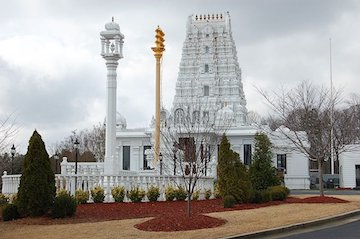
It turned out that I could not get to a parish for Mass on the feast, given my hosts’ warm welcome of me. We came to the temple a few hours before my lecture, and joined in the morning abhishekam, the routine but important ceremonial bathing of the main deity, Venkateshwara — Vishnu, Narayana. Visnu is iconically represented in an impressive image carved in dark stone, Visnu as Lord of Tiruvenkatam, the famed temple site at Tirupati in Andhra Pradesh — an iconic presence installed at the Pittsburgh Temple decades ago, and worshipped regularly ever since. The abhishekam is an elaborate bathing of the sacred stone image, with water, milk and other liquids, done by a main priest, as ancient hymns are sung by several reciters, including, yesterday, at least one congregation member who knew the hymns very well.
I was an honored guest for the hour-long rite, seated on the floor (as everyone was), front and center just outside the inner sanctum. It was a memorable event, ritually compelling, ancient in its roots, and clearly intensely meaningful to the devotees. By the music, incense, flowers, and presentation of the deity, all the senses were involved – such is a key point of the rite, and all of us present left with vivid images of the deity bathed and presented resplendent again (as we saw when we visited the same area after my lecture). After it ended, we left the immediate setting, and outside it, received prasadam, a gift of some mixed raisins and nuts revered by tradition as given by the deity, a kind of communion
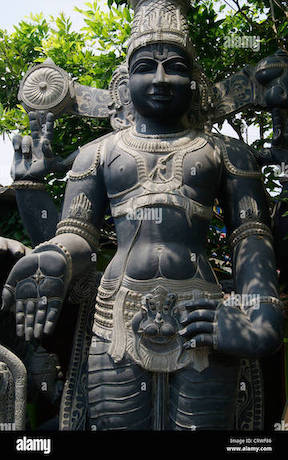
This was an unusual way to mark Corpus Christi, indeed — odd, many might say, even unholy. But I make no equation here, as if the abhishekam and the mystery celebrated on Corpus Christi Sunday are “the same” or “just as good”, etc. Rather, I filtered my temple experience through my mindfulness of our Catholic feast. At a primal level, the showing of God in human form, such as can be seen and touched, seems to resonate —Corpus Christi held in balance alongside the regular worship of the deity in the abhishekam. The words from my sermon last year came to mind after Sunday’s events were over: “Only if we—persons, people of faith, theologians—give ourselves as fully, recklessly as did Peter — who testified that for him Jesus was the only way — all will be well. Otherwise, we may find ourselves drifting away, as did the crowds.” Going out, going deep, are part of the Christian faith, and experiencing this in a Hindu temple is for some of us a good way to mark and bear witness to our faith.
Interreligious dialogue, we all should know, is not just a matter of words. It is also palpable, visual, rich in the senses – and a bit reckless, since our bodies and senses race ahead of where our minds and words bring good order to life, Catholic or Hindu or secular. No longer president of the CTSA, I seek to live out what I said as president last year, in the homily, but also in the presidential address, which connected Corpus Christi to my fifty years-plus of learning from Hindu traditions: “experiencing a kind of liminal status also opens into the freedom essential to our movement forward as individuals and a Society. Being an inside-outsider is a good basis for reimagining who I am, who we are.” Past-president of the CTSA, at a Corpus Christi one year later, now in a Hindu temple, I have continued to seek to be Catholic, and live out my faith, in the borderlands where traditions meet, that I might report home what I have seen and heard, tasted and smelled, in bodily sacred traditions so different from my own.