
The Good Samaritan In Unneighborly Times
Loving the Neighbor Almost by Accident
The Good Samaritan parable is told by Jesus In Luke 10, a learned scholar has been testing Jesus – “what must I do to inherit eternal life?” – and in turn is pushed by Jesus to give the very essence for Law:
You shall love the Lord, your God,
with all your heart,
with all your being,
with all your strength,
and with all your mind,
and love your neighbor as yourself.
To justify himself, the man asks, “Who is my neighbor?” — his practical follow-up to the teaching, since apparently he thinks love of God entirely and without reserve is clear enough – and Jesus tells one of the most famous parables.
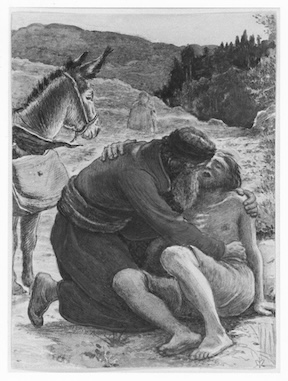
Most readers of this brief blog know by heart the story of the Good Samaritan: the unnamed, unidentified person stripped, beaten, left for dead; the evasions of the priest and Levite who, opposite to the coming-near that defines “neighbor” are non-neighbors, determined to keep their distance on the other side of the road. It is not that they object in any specific way to the man by the roadside since he has been stripped also of markers that would define him as rich or poor, Jew or Samaritan, priest or Levite or ordinary citizen. He is just a wounded, vulnerable, desperately in need human being. It is the Samaritan who acts like a neighbor, crossing the road so as to come near to the man.
How inconvenient to come near and see the problems first hand. He knows that thoughts and prayers will not do, a modest or generous donation is not enough. The man is bruised, bleeding, and the Samaritan has to use what he has – his oil and wine, perhaps strips of cloth torn from the shirt off his back – to staunch the bleeding and begin a healing process. That too is not enough: he must take the man, on his own donkey as he himself now walks, to an inn. He stays with him overnight. But even then, he cannot walk away – he gives silver coins to the innkeeper to care for the man, and promises to come back and pay even more, until the man is restored and able to go home. Such a commitment! One can see why the priest and Levite passed by, as far away as possible. Perhaps they knew what would be entailed, perhaps they had helped once before – and could not imagine doing it again.
The scholar of the law came to test Jesus; then he wanted to justify himself by certainty about which people are his neighbors and to be loved; and in the end, the question on how to gain eternal life turns into an everyday challenge: “Go and do likewise”. What more need be said?
It is important not to make too much of a parable, but there is also value to taking it as it is: not an appeal to concerted action, or plans for social change — worthy indeed, but on another day — but rather, every day, on every road, be alert. Something may happen, some person enter your field of vision, who needs your help, suddenly, inconveniently, desperately. Be ready to come near to the person in trouble, to see their needs and wounds close up. Then do something. Binds the wounds, even with strips of your own shirt; take them to the inn, and giving up on your schedule, stay with them; then later, come back again. And again.
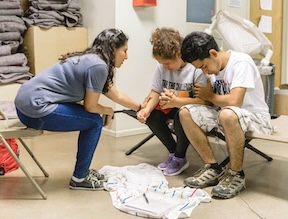
OK — but then, you may ask, what about the subtitle: “In Unneighborly Times”? There are big and important things to be done, mass action is needed, living, alert and brave elected officials, resistance. But even now, especially now, there is the local, seemingly small choice every one of us faces everyday: will I be a neighbor, come close to a bare, ruined stranger – my sister, brother, in truth – on the street I just happen to be walking down? Coming near to one person may seem a small gesture, but if every person of faith commits to this accidental, on the road love-in-action — if each of us acts like the Samaritan just once, stopping aside from routine and business (busy-ness) for an extravagant act of love — then no proud selfishness, no cynical lie about the poor, no very selective understanding of religion that imagines love of neighbor to be optional, will be able to stop the ancient yet still emerging revolution: as you love God, love your neighbor, love yourself in those loves.
Tiny choices add up to the unstoppable. It is hard at this point not to think of words that William James once wrote in a letter:
"I am against bigness and greatness in all their forms
and I am for the invisible molecular moral forces that work from individual to individual,
stealing in through the crannies of the world like so many soft rootlets,
or like the capillary oozing of water,
and yet rending the hardest monuments of man’s pride, if you give them time.
The bigger the unit you deal with, the hollower,
the more brutal, the more mendacious is the life displayed."
(Based on a homily given on Sunday, July 13, 2025)