
Roger and Me
A personal reflection on the life, work, and inspiration of Roger D. Haight, SJ
Roger Haight, S.J., died on June 19, 2025, in New York City. Like so many others, I have been missing him these past several weeks. I have been thinking about his influence on me—how much he enriched me as a person, a Jesuit and a theologian.
Roger and I once team-taught a course, in 1999, while I was still at Boston College and he was still at Weston Jesuit School of Theology: “Krishna and Christ”. His more systematic theological and philosophical style contrasted with my particular, from-the-primary-text up Catholic way of thinking about Krishna, but the back and forth on themes and texts added up to a fine course. The students seemed content, and for me the course was a privilege, intellectually stimulating, and most enjoyable.
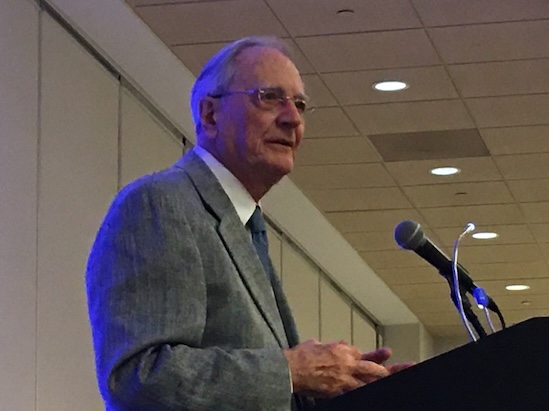
Sadly, it turned out to be Roger’s last class at Weston, before he was pushed off the faculty due to Vatican concerns about the orthodoxy of Jesus, Symbol of God. In a Notification released in 2004, the Congregation for the Doctrine of the Faith (now the Dicastery for the Doctrine of the Faith) formalized its concerns about the book. It judged that the book “contains serious doctrinal errors regarding certain fundamental truths of faith.” (Further explication of the C.D.F.’s reasoning can be found in the Notification itself.) The Notification concluded with a declaration that “until such time as his positions are corrected to be in complete conformity with the doctrine of the Church, the Author may not teach Catholic theology.” Thus chastened, Roger had to leave the Weston Jesuit faculty and teach there no more.
The process leading to all this was under way before our course was taught. It was a difficult moment and a poignant one, that Roger’s teaching career at Jesuit institutions should end so abruptly, and with a course that itself was exploring the limits of our learning of God. I was both sad and honored to be there for that last course.
Even before 1999, I knew Roger, by reputation and personally. I admired in particular his 1995 Catholic Theological Society of America Presidential Address, “Fifty Years of Theology”. His short and simple homily at the Society’s online convention in 2020 was a fitting spiritual application of the presidential, 25 years later. Other writings too stood out. His 2019 Theological Studies essay, “The Birth of American Catholic Theology”, was a great service not only to TS, but also to the Catholic theological community in general as we benefited once again from his erudition, increasingly long historical perspective, acute sense of the moment, and down to earth yet daring vision about where theology is going, has to go. And everyone knew about Jesus, Symbol of God (1999). Those who actually read the book still found in it much to think about and learn from, whether agreeing or not with Roger’s overall Christology.
In the years of investigation and disciplinary actions, Roger’s equanimity under pressure was admirable, even astonishing. He was a master of Ignatian indifference, even a kind of yogi, fearless, at peace no matter what successes or failures arrived next. He edified us all: no loud media platform, no angry denunciations, but simply a quiet adamantine refusal to give in to pressure. He’d done the best he could to think, understand, and write, and he could not back down. He could be criticized, even condemned, but he would not back down.
His mix of humility and strength was also fruitful. He quickly found new opportunities to flourish over the next decades of his good life. At Union Theological Seminary, for instance, he quickly became a beloved teacher, colleague, friend to so many who might never otherwise have met a Jesuit. There he had the opportunity more than once to offer the Exercises to a mixed group of Catholics, Christians of various denominations, people in other religions, and seekers. Remarkably, out of the experience came Christian Spirituality for Seekers (2012), a book I keep recommending to colleagues and students.
Later on at Union, he was invited to offer a course on “how Christian spirituality as a practice and discipline might support the lives of people who work against the many forms of social injustice that infect our lives today.” He researched the topic, filled gaps in the theology and spirituality of confronting racism, taught the course — and soon enough Facing Race: The Gospel in an Ignatian Key (2024) came forth, his last book. Saying no quietly had opened new and fruitful vistas that otherwise would have been closed to him and us.
Forgive me if I flatter myself by imagining that Roger and I are kindred spirits among Jesuit intellectuals. We were both New York area Catholics from birth, we both had international experience early on in our Jesuit lives, his during studies and regency in the Philippines, mine beginning with regency in Nepal.
We both were affected, irreversibly, by that time far away from our deep, home-grown Catholicism. His horizon became global, free to range back and forth across the intellectual boundaries of the West. I was smitten by the religious realities I began to learn in Nepal, as an inner space opened up for me, one that has never closed. We both tried to be dedicated Jesuit intellectuals undeterred by where we might end up when our thinking crossed into uncharted territory.
We followed our thought — intellectual, visceral, spiritual — wherever it led. Roger spoke for both of us in his essay in Jesuit Postmodern: Scholarship, Vocation, and Identity in the 21st Century, a 2005 volume I edited:
“When I think of the specifically Jesuit mission in and for the church, I instinctively and spontaneously turn to the metaphor of a boundary. I situate the Jesuit on that boundary, as between two places or facing opposing forces, with the task of mediating between them in both directions… Sometimes Jesuits get in trouble, on either side of the boundary, but if that never occurred, Jesuits would not be fulfilling their corporate responsibility.”
Even if we were kindred spirits, in style and detail our actual work didn’t have a lot in common. Both of us were attentive to issues inside and outside the Catholic world, but in different ways. We almost never quoted one another’s writings. Nor could I give the serene, comprehensive, utterly lucid and constructive discourses Roger gave on so many occasions, such as his major CTSA addresses. In my own way, I have tried to be universal in a deep particularity, teasing out wider truth, broader love, on that inner edge where the truth and beauty of Catholic tradition meet the truth and beauty of Hindu tradition. I admire deeply what Roger was up to, and I am grateful that he also affirmed my work as necessary thinking. We were companions on the path, though always a few steps apart.
I always kept in touch with Roger, at conferences, in New York, or when he visited Boston and stayed with us in Cambridge. We’d meet for lunch or dinner or a drink at the CTSA or AAR. Rather awkwardly, not realizing the seriousness of his situation, I sent him a friendly email on the very morning of the day he died, to congratulate him on a recent video discussion of Facing Race with a few young Jesuits.
What might have been: I concluded my email by asking him what his next book would be.
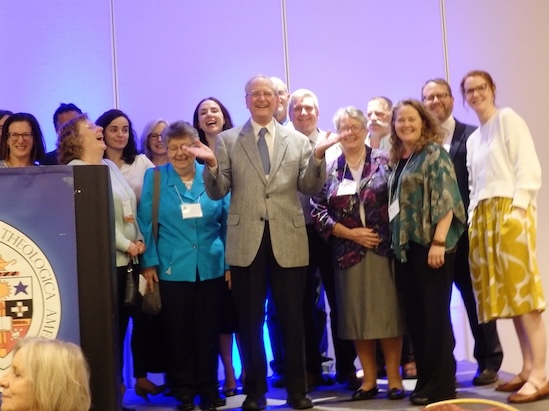
Our final sustained contact was at his last CTSA convention in 2023. I was president that year, and honored to present to him our John Courtney Murray lifetime achievement award, a long-deserved honor that came just in time. Everyone at the banquet was thrilled to celebrate all that Roger had taught and written, Roger as our friend and teacher, our theologian, our favorite Jesuit.
When at the end of the citation I uttered his name, the 400 theologians in attendance rose up for a five-minute standing ovation that reverberated through the room, perhaps the entire hotel. For so many of us, Roger marked off a breathtakingly wide horizon in which we, agreeing with him or not, could fulfill our mission for God’s people, as he did from the beginning to the end.
This is an edited version of the essay appearing online in America, the Jesuit Review, on July 3, 2025.