
In the Light of the Cross
Peering into Violence: Iryna Zarutska and Charlie Kirk in the light of the Holy Cross
They shall look upon him whom they have pierced. (Zechariah 12; John 19)
The Exaltation of the Holy Cross: September 14's feast commemorates the venerable tradition that St. Helena, mother of the emperor Constantine, discovered the cross of Jesus, and made it available to be seen, venerated already in the 4th century and later on in Christian communities east and west.
The history of the discovery and veneration is complex, but the force of it today is sure and true: the cross, often pictured with Jesus nailed to it, offers a site for contemplation, for seeing into a horrendous act of violence that is also a scene of great love. In our world where violence is frequent, very available to watch in various media, the manifestation of the cross can help us to see and see through the violence of our times.
Today’s three readings (in Catholic tradition) suggest successive ways of understanding the meaning of the cross — as a place of sorrow; a pathway to a new birth; the foundation of a new community, after violence is vanquished..
Numbers 21 tells us of the strife and bitterness of the Israelites in the desert, a punishing plague of venomous serpent which afflict the people, and Moses’ remedy, at God’s command, the making of a serpent of bronze that when gazed upon cured people of the poison and the bitterness. The scene can be taken too literally, it seems, as if the bronze serpent itself heals and protects: 2 Kings 18 reports that people were worshipping the serpent, which was then destroyed by King Hezekiah.

The Gospel according to John brings us back to the scene. 3:13-17 excerpts a passage from the night visit to Jesus of Nicodemus, a Pharisee and “a member of the Jewish ruling council”. Nicodemus senses that Jesus is offering something new and life-giving, but he is fearful of being criticized as gullible or unfaithful to tradition. But then he also balks at Jesus’ word that we must be born again “of the Spirit”. He unable to understand how rebirth could possible, or what manner of rebirth is possible in an adult person. Jesus responds by hearkening back to Numbers to show how one might picture his coming exaltation — crucifixion, resurrection: “Just as Moses lifted up the snake in the wilderness, so the Son of Man must be lifted up, that everyone who believes may have eternal life in him.” To see Jesus uplifted opens a way to radical change: we just have to contemplate his crucified and risen form, and let ourselves be drawn into what we see.
Finally, Philippians 2 gives us Paul’s exhortation to the community in Philippi. He begs them to learn to live in harmony with one another: comforted by Christ’s love, sharing in the Spirit, humble and not selfish, “like-minded, having the same love, being one in spirit and of one mind” — the new community that is urgently needed. How? Again, by contemplating Christ crucified: “Christ Jesus, being in very nature God, did not consider equality with God something to be used to his own advantage. Rather, he made himself nothing by taking the very nature of a servant, being made in human likeness. And being found in human form, he humbled himself by becoming obedient to death—even death on a cross.” If we contemplate Christ in his self-emptying, his unreserved love, we will begin to be that way ourselves. Gazing in a community on the cross makes us a counterbalance to the mobs of violence in thought, word and deed, all around us.
So much for the readings (about which much more could be said.) I included in my homily for this feast recognition of the acts of violence all around us right now. In a week where we commemorated the 24th anniversary of the 9/11 massacre, and see images of horrific violence in the Ukraine, Middle East, South Sudan and elsewhere, violence seems to be winning. It is all the more visible in the media too. Most of us have seen the moment of Charlie Kirk’s assassination in full public view on a college campus just a few days ago, we can easily find images of Iryna Zarutska, the young woman who in August was killed seemingly at random by the man sitting behind her on a train.
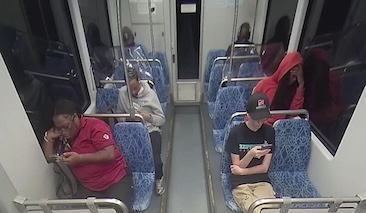
Inevitably, such acts of violence provoke debate across the US and the world, and all kinds of political and social questions are raised, often with great heat. Right or left or center, we can share in those debates, ideally with a certain gentleness. But I suggest, as I did in my homily, that something specific we can do at this point is practice engaging in a steady and sustained contemplation: look at the cross; look at images or videos of the recent murders; look at the cross; look at the wholesale slaughters occurring around the world even right now.
This kind of sacramental gazing back and forth can help us to be healed and to become the kind of people able to contribute to the work of healing in a wounded world. This gazing enables us to imagine our radical new start, rebirth, passing from violence to peace, death to life, hatred to love; a gaze that we can share, in church and in every public space, such as fosters community - Catholic, Christian, beyond to every human community and even all living beings, that begins to be “like-minded, having the same love, one in spirit and of one mind”.
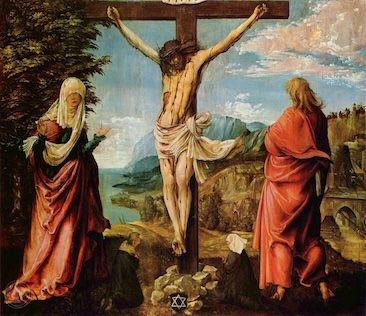
Tomorrow (September 15) is the feast of Our Lady of Sorrows. To return to John a final time, it seems that John 19 Mary is the primary example of how to stand and see in the face of violence: “Near the cross of Jesus stood his mother, his mother’s sister, Mary the wife of Clopas, and Mary Magdalene.” Mary and her sister Marys stood there, watched, took in the horrific violence without turning away. The sorrows of her son are her sorrows and, in the light of the cross, she makes her own all the sorrows around us.
We have much to do. But one thing we can do is return to this venerable contemplative practice: quietly gazing on the crucified Jesus, and seeing all around him, with him, all victims, the known and the neglected, forgotten. With Mary, Iryna and Charlie and a host of others, there where Christ’s love amid suffering shines forth.
(Written after a homily given for this feast, September 14, 2025, at Our Lady of Sorrows Parish, Sharon MA.)