
Five Weeks Abroad
Reflection on my travels to three continents and five countries, and home again
I am on sabbatical this semester, busy with writing projects and so mostly staying at home here in Cambridge. My main opportunity for travel was a trip of five weeks abroad, October 13 to November 16. For me at least, it was an impressive trip, which took me to three continents (Africa, Europe, Asia) and four countries (Kenya, Belgium, Nepal, India), with about twelve flights and many airport hours awaiting take-off. I had not planned so elaborate a journey, but my plans and a series of invitations quite remarkably came together, as if the calendar had been planned to make it all happen in just one trip.
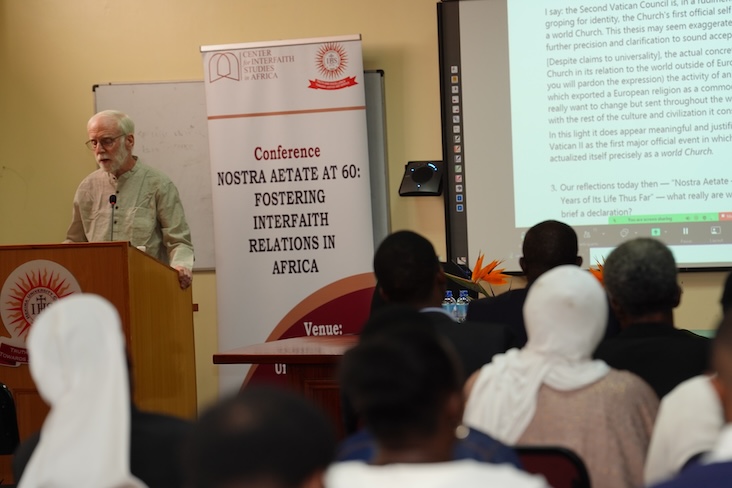
I began in Nairobi, Kenya, my first visit there. I was at Hekima University College, to keynote a conference on Vatican II’s interreligious document, Nostra Aetate (“In Our Times”) at 60. I argued that we are still only early in an era of deep and committed interreligious learning, an era that will happen most importantly and vividly in Africa and Asia, even as Catholics in Europe and America reinvent what it means to be Catholic in secular and postmodern societies.
I also gave a broader lecture at the Jesuit Historical Institute of Africa, on what we can learn from our missionary predecessors, and where we must part company with them. My hosts were Fr. Norbert Litoing, SJ (Harvard PhD in Religion, 2024) and Fr. Jean Luc Enyegue, SJ (Boston University PhD in History, 2018), and soon to be a new provincial superior for the Jesuits of West Africa. Both Norbert and Jean Luc had lived with me in our house here in Cambridge, during several years of their studies, and it was good to meet them again, now in Africa.
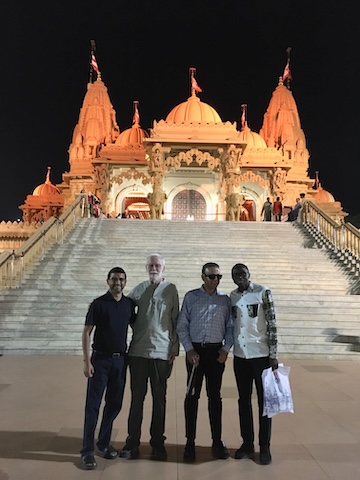
Sidelights to my week there included celebrating feeding giraffes, handling a young boa constrictor, Diwali at a Hindu temple, and a very pleasant city tour guided by Mr. Cyrus Habib, SJ, a young Jesuit working in Nairobi for two years, before his final studies toward ordination.

A week later, I flew to Brussels, and by a brief train trip reached Leuven, the old university town, to participate in a conference on the occasion of the 600th anniversary of the Catholic university, KU Leuven, where Dutch and English are the main languages. (Nearby is the French-speaking campus, Louvain-la-Neuve.)
The conference speakers focused on both the history and future of Catholic universities. It was a marvelous event, wonderfully hosted by the planning team, and rich in splendid, forward-looking papers. Rain and cold did not stop us from enjoying the charms and warmth of this old university town.
In my plenary, I proposed that if there are to be Catholic universities in the future, their catholicity has to be robustly hospitable, hosting many religious and intellectual traditions, all thinking and educating, probing spiritual realities together, in a conversation neither fundamentalist nor secular. A few Catholic universities will be best hosts for all this, a hospitality that will provide a rationale for Catholic institutions in this century. At 75, I will probably not live to see this hope fulfilled, but I thought it best to reach for that brighter future rather than to wallow in pessimism or support a retreat of Catholics into safe enclaves.

After the conference, I flew to Kathmandu, Nepal, for a ten-day visit. This was the heart of my trip and its original purpose: visiting the city 52 years after my first visit there (though with four in-between visits over the decades) for a series of reunions with students I had taught during my original stay there, 1973-1975.
Decades have passed, and trying to catch up in a few hours seems impossible, and yet we did — enjoying each other’s company, and grateful that although we rarely see each other, our lives are all the better for having been intertwined when we were young.
Highlights include a visit to St. Xavier’s School, now much bigger than when I taught there, and good conversations with Fr. Greg Sharkey, SJ, the sole American Jesuit there now and a popular figure in town, professor at Kathmandu University in Buddhist studies, and host to visitors like me. I also enjoyed a (for me) daring ride across town on the back of a motorcycle, exhilarating and surely dangerous too.

And finally, India: I traveled for the first time to Udupi, an old temple town on the west coast of India dedicated to the worship of the deity Krishna.
Here there was a conference on the famed Bhagavad Gita, not so much an academic event as a celebration of the Gita as fundamental to the intellectual and spiritual traditions of India.
I got to see many of the sites connected to Madhva, the revered fourteenth century theologian who was a strong proponent of dualist (dvaita) Vedanta, which holds to a strict difference between God and all living beings created by God.
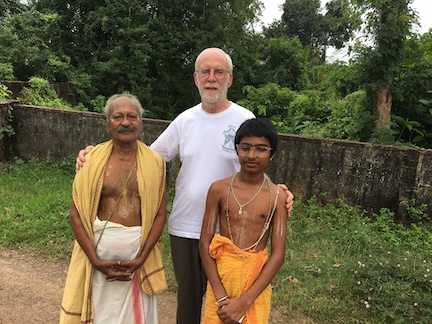
Visiting a traditional Sanskrit school was a bonus, since I was able to observe and meet boys studying in Sanskrit, by traditions that surely have roots reaching back to Madhva’s times. Such learning, though less popular today, ensures a way for ancient traditions to survive in an increasingly diverse and secular India.

My last stop was in Goa, the old capital of Portuguese Asia that as a Western site dates back to around 1500. There I gave six lectures or presentations in five packed days. We also visited the famed Mangesh temple, dedicated to lord Shiva.
I spoke at the Xavier Historical Institute, and at the Birla Institute of Technology and Science, Pilani, where I was hosted by Dr. Anu K. Antony, who had spent time at the Mittal Institute at Harvard several years ago, and at a café named The Flying Goat and at the best bookstore in Goa, Dogears.
Fr Rinald D’Sousa, my host, gave me an expert tour of old Goa and its many churches, explaining the history of religious orders there. I revisited, for the first time since 1983, the tomb of my patron, St. Francis Xavier, and was able to offer the Catholic Mass at his altar.
On November 15-16 trip of 34 hours door to door brought me back to Cambridge, to recover slowly from jetlag and 10.5 difference in time zones and, among other things, write this blog: what did it all add up to?
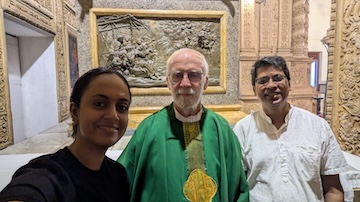
Past: it was first of all journey into the past — 600 years of a Catholic university, of course, and a Goa so rich in the history of the Western colonial era and the site of the first ministry in Asia of a Jesuit, Francis Xavier.
Even in Nairobi, a visit to the wonderful national museum invites us to take a trek through history — from the very ancient first traces of human life to the rich cultures of the precolonial period, to the upheaval that came with the sudden arrival of Europeans in the 18th and 19th centuries, to the current vitality and challenges of a free society.
And for me, being in Kathmandu and meeting the boys I taught – still vibrant and alive, even if mostly retired grandfathers – took me back through my history to those years in the Himalayas when my personal and Jesuit life found its direction, in a practice of interreligious learning that continues even today. (I have a chapter on Kathmandu in my 2024 memoir, Hindu and Catholic, Priest and Scholar: A Love Story.) At the tomb of St. Francis Xavier, both the 500 years difference and our spiritual proximity seemed real, at the same time.
Present: the whole trip was in the present moment too. I could see what was happening around me, including political events – e.g., the death of Raila Odinga, a revered senior political leader, in Kenya; the aftermath of several September days of intense violence in Kathmandu, September days; a fatal bombing in New Delhi just before a traveled to the airport there. I myself was most confronted with the present moment when my turn to speak came at the academic conference in Udupi. Only the night before did I learn that I would be speaking to a crowd of 600 people. I had to put aside my paper, “Teaching the Bhagavad Gita”, to craft, in a few notes, a plea to those present to let the Gita be their teacher, a teaching that in its full form is accessible only to those who give themselves over to the study of it from the first sloka to the 700th.
I cannot say whether I was saying something new, not said already in the many speeches given in Kannada. But it seemed unique for me, the Catholic from the West, to be pleading to an entirely Hindu audience, to actually read and study this revered Hindu text, so as to learn from lord Krishna: In an odd way, everything I’d learned in all these years about study and teaching was somehow compacted in the 30 minutes or so that I spoke, from my heart to their hearts. It seemed to go well.
Future: my visits particularly to Nairobi and Leuven also prompted me to reflect on the future that is already under way.
Certainly, in an era when the future of Christianity and religious orders like the Society of Jesus, lie in the global south and global east, it is obvious that Africa — so huge a continent, so diverse — will have a leading role for hundreds of years to come. No longer will Europe and the United States lead the way and get to explain the meaning of Christianity today.
It is challenging, thrilling, and a bit unsettling to witness the birthing of a Church and Society of Jesus that will grow up and flourish most fully only long after I am “history”.
Everywhere I went, I was an ambassador — unofficial, to be sure — for Harvard, particularly the Divinity School. In our difficult times, I was asked again and again how Harvard is doing, managing various challenges. In particular, many wanted to know what is happening at HDS. Professors, students, and other religious intellectuals were fascinated by the diversity of HDS, the multifaith reality of our student body, staff and faculty, and our impressive communal effort to build a community of learning, spiritual growth, and life together that crosses all boundaries. The world is vast, and change beyond anyone’s control — but HDS does have a role as it honorably fulfills its distinctive, one-of-a-kind 21st century mission. It is good to be home.